
Read and discuss: Play development and play schemas
Reading & Discussion
Read short examples of play development and get familiar with the concept of play schemas.
When children first play with an adult
The first experiences of play happen in interaction with adults and are based on connecting with the children, using physical touch, engaging facial expressions, smiling, movement and eye contact. Simple games, hopping, rhymes, and little songs are very important in creating this connection. The activities help a child’s early communication skills and language learning, and they help them to form positive social bonds. Rhymes and nursery rhymes not only pass down cultural traditions but also help children imagine different situations. A child who is left alone during this stage might find it hard to move to the next level of development.
The child's sense of self leads to new forms of play
A young child’s growing awareness of their own separateness is evident in how they interact with objects. For a six-month-old baby, objects are part of themselves, but by the age of one, they start to notice that objects can be something else—things that adults use in special ways for specific purposes. The child realises there are two separate entities: themselves and the object, and they begin to combine two objects or two words to form a sentence. This new awareness of their own separateness can make the child feel fearful and create a renewed dependence on adults. A child who has learned to play independently may start to cling to an adult once more.
At the turn of the first and second year, proper pretend play with dolls and plush toys helps the child progress in their development. Nurturing instincts are fostered through gentle play, such as caring for dolls and reenacting family interactions observed by the child. These experiences are essential for all children to develop empathy and understanding of social interactions. As educators, it is important to pay special attention to nurturing play during this stage of development, as it helps children practice the crucial skills of expressing and receiving empathy, compassion, and care.
Play and language are interconnected; the structure of actions and language are learned hand in hand. The adult’s example is essential for the emergence and development of a child’s imagination and language development.
The emergence of imaginary play
As children start to understand meanings, they soon begin to show early signs of imagination. A child might climb into a doll’s bed pretending to sleep or use a banana as a phone. This marks a significant step in their development, as they gain the ability to imagine, which helps them plan for the future, reflect on past events, create mental images, and act accordingly.
During play, children often use improvised tools to simulate activities, such as driving a car, even though they are not physically moving to different locations. These substitute tools and actions are essential in developing a child’s mental functions and serve as foundational steps toward abstract thinking.
Through play, children learn to work together towards a goal and share tasks. They develop the ability to focus on a specific objective without being distracted by other events. Imaginative play involves creating scenarios with a clear structure and plot, adopting different roles to interact with others in specific ways, and using language that mimics adult conversation. This type of play is typical for preschool children and can continue into early adolescence.
From imaginative play to role play
By the age of three, children typically begin to mimic sequences of actions and name their roles. At approximately four years old, they reach the peak of role play: they enjoy assuming roles, constructing play worlds, and, with a more experienced playmate, creating coherent plots. Play explores multiple aspects of life, using available tools to give new meanings to the environment: “Hey, here’s the door…”. It’s the adult’s role to ensure the necessary tools are available for play.
In preschool years, role play becomes more diverse as children, with improved fine motor skills, start using small props and can take on multiple roles simultaneously. Construction play enhances spatial skills and supports children who enjoy building and constructing through role play by linking their creations to pre-made structures. In the FinlandWay® classroom design, we recommend having a designated small world and construction play corner. This setup provides children with opportunities to engage in construction play and integrate it into role play, such as building houses and using animals and characters to create stories about who lives in those houses.
Narrative drama, fairy tale, and storytelling play
Narrative drama, based on fairy tales and stories, involves children either playing independently or together with adults. The idea is inspired by a story, and the players incorporate their own desires into it. Creating play environments that match the theme allows for a cohesive blend of play and drama. Play turns into drama when adults participate, emphasising the importance of adults in children’s dramatic play. Drama play offers adults a fruitful possibility to immerse themselves in role-playing, and present themselves to children in a new light as playful individuals.
Dramatic play enhances children’s abilities towards rule-based games, as players must closely consider the character of their role model and the events of the story. Both aspects are challenging for children and, under the guidance of a skilled player or adult, form a zone of proximal development where play motivation can be linked to learning about real-world concepts.
Adapted from: Leikin Aika (2004) – Finnish ECE Teachers Union
WHAT ARE PLAY SCHEMAS?
Play schemas refer to repetitive patterns of behavior that children exhibit during play, which reflect their understanding and exploration of the world.
These schemas are crucial in early childhood development as they help children learn about their environment, develop cognitive and motor skills, and make sense of new experiences.
Some children can have a predominant shcema they keep exploring and repeating, when others can engage in more than one schema at a time.
Especially teachers in FinlandWay® Nursery and Kindergarten 1 age groups should be paying special attention to understanding play schemas when they observe children’s play and behaviour.
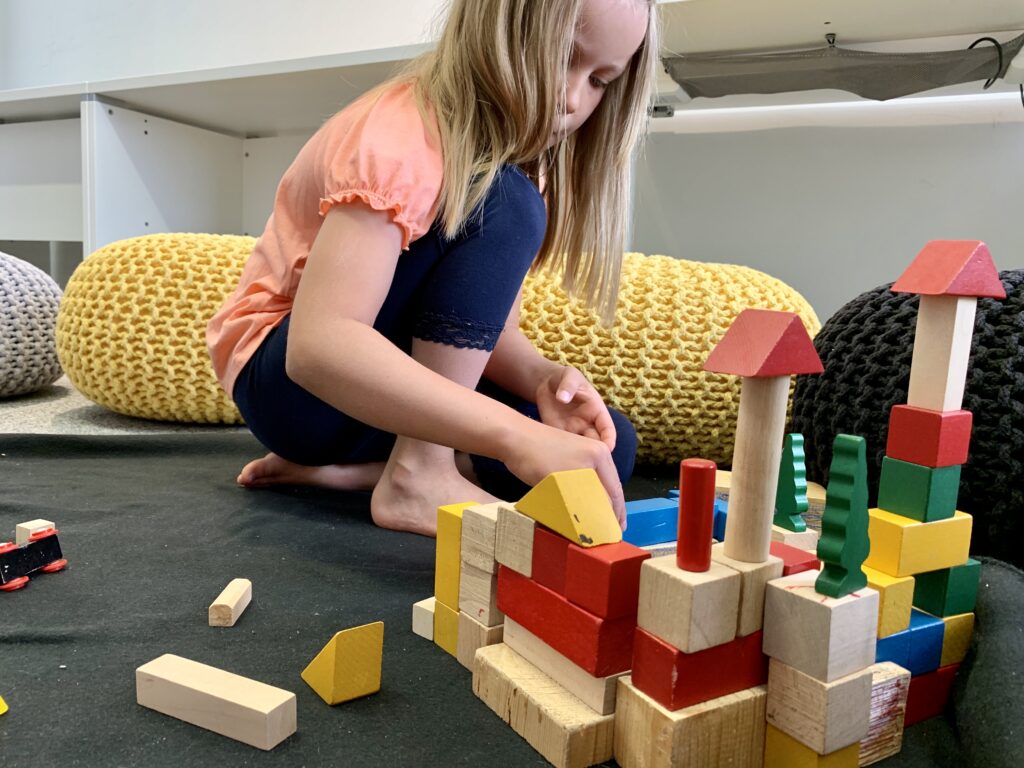
Understanding play schemas is valuable for educators
Recognising and facilitating these schemas can enhance cognitive, social, and motor skill development. Schemas also allow children to explore their environment in a structured way, promoting curiosity and learning. By identifying a child’s preferred schemas, educators can tailor experiences to better meet chidlren’s individual developmental needs.
COMMON SCHEMAS IN YOUNG CHILDREN’S PLAY
Trajectory – Children might be throwing items in various directions, climbing up and jumping off. This is one of the earliest schemas observed in babies. Children are fascinated with how they and the objects move.
Enveloping – Play might include activities such as wrapping self in a blanket, covering whole painting with one colour, putting notes in envelopes to post. Children are interested in hiding and covering items, as well as filling and emptying bags and containers.
Enclosure – Children can be filling and emptying containers, climbing into boxes, making dens. They show interest in enclosed spaces like tunnels, tents and cardboard boxes. They might also build these for their toys.
Transporting – Play can include carrying small items round in bags and buckets, or pushing other children and objects round in prams and pushchairs. Children might ne repeatedly moving resources around and from one place to another.
Rotation – Typical activities can be rolling and being spun round being fascinated by the physical experience of twirling and twisting their body. Children can enjoy playing with spinning or wheeled toys, or enojoy rolling tyres around. They might also want to turn taps on and off or watch the washing machine on a spin cycle.
Connection – Children might engage in joining furniture with wool or ribbon, connecting and disconnecting train tracks, sticking boxes and models together. They explore how to join items together and might enjoy art activities of gluing and sticking pieces together or putting beads onto string.
Positioning – This schema can include lining up objects, walking round the edge of things or laying under furniture, being particular about where food goes on their plate. Children might also explore order and sequencing with objects.
Assembling – Children can be making piles, or arranging things by lining items up or stacking things randomly or neatly. This might happen with construction play but also with any items the child can find.
Early Years Coalition. (2021). Birth to 5 Matters: Non-statutory guidance for the Early Years Foundation Stage. St Albans: Early Education. Schemas, pdf handout. Available at https://birthto5matters.org.uk/wp-content/uploads/2021/03/schemas.pdf
Discuss with your group
-
What stages of play development have you observed in children’s play in your classroom?
-
How can play schemas explain children’s behaviour that seems repetitive?
-
What play schemas have you observed in children’s play during your educational career or with young children in general?
Your coordinator will write down the discussion notes.